
Vertical
Vacation Rentals & Cabins
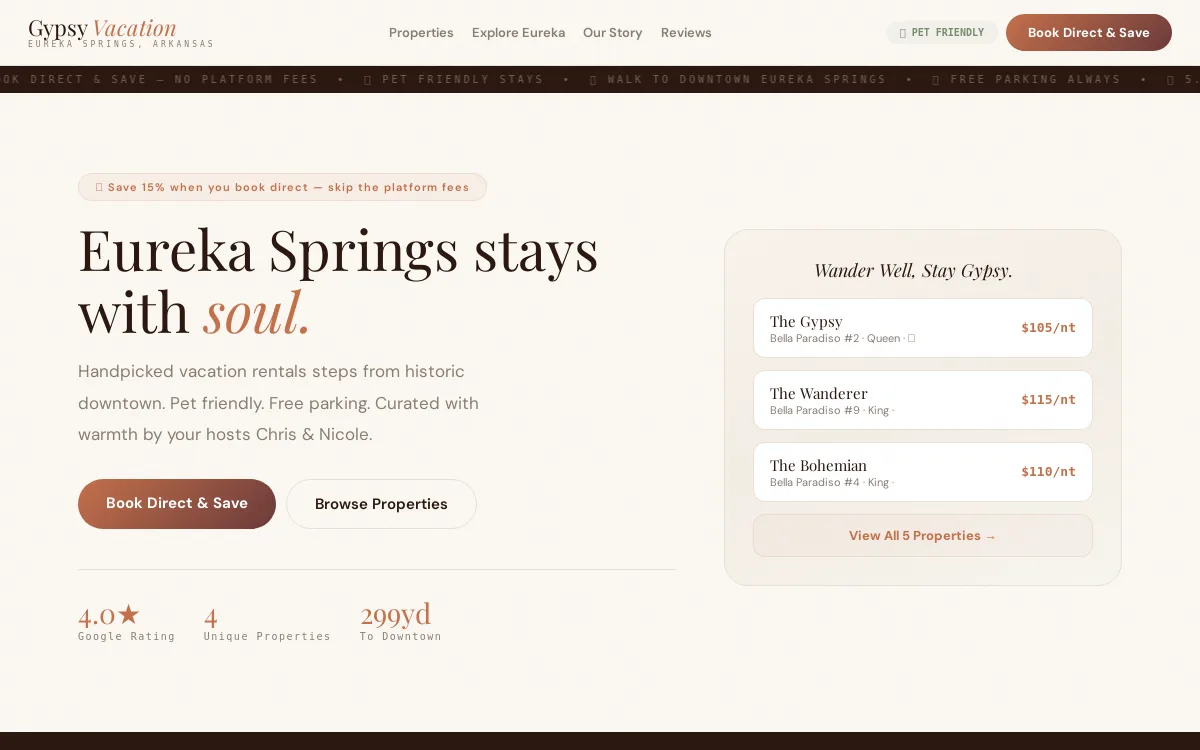
LodgingBusiness schema with booking integration, location SEO, and seasonal-pricing-aware content.
6 live builds in this vertical.
Paying-client case studies
Demo builds
Need a site like these?
Tell us what you're building. We'll match the right pattern.
Start a project →What this vertical needs to rank
A vacation rental or cabin website is competing against the listing platforms that own the guest relationship. When someone searches "cabins near Table Rock Lake with a hot tub" or "pet-friendly Ozarks rental for a long weekend," the top results are usually Airbnb, Vrbo, and aggregator pages, not the property owner who actually answers the phone. The job of a direct-booking site is to win the searches those platforms cannot dominate: your branded name, your specific property or cabin community, and the local intent around a named lake, town, or trailhead. That means each cabin gets its own indexable URL with real text, not a single page that swaps photos behind a calendar widget.
The buyer intent here is dated and conditional. Guests filter on dates, occupancy, amenities, and a destination at the same time, so the content has to answer all four before they click back to compare on Vrbo. The pages that convert spell out sleeping arrangements, exact amenities (hot tub, fire pit, dock access, full kitchen, pet policy), the drive time to the attractions people actually came for, and a clear cancellation and check-in policy. Vague "cozy retreat" copy ranks for nothing and answers nothing; specifics are what both guests and AI answer engines can quote.
Schema is where lodging sites either get rich results or stay invisible. The correct types are LodgingBusiness (or its subtypes Resort, BedAndBreakfast, or Campground) for the business, with geo coordinates, amenityFeature entries, checkinTime/checkoutTime, and petsAllowed. Individual properties marked up with an Offer and per-night priceSpecification let search engines surface availability-style results, and genuine guest reviews carried as Review with aggregateRating are the trust signal that moves a hesitant booker. Pair that with a real FAQPage for the questions every guest asks, and the listing becomes something an AI Overview can summarize accurately instead of guessing.
Trust is the conversion bottleneck for direct bookings. A guest who would book a name-brand platform without a second thought needs more proof to hand a card to a website they have never heard of: visible reviews, real photographs of the actual unit (not stock interiors), a physical location, a transparent total price with cleaning and pet fees shown before checkout, and a fast, secure booking path. The most common reasons cabin and rental sites fail to rank or convert are duplicate thin pages across near-identical units, photos that load slowly and kill mobile experience, no destination or area content to capture local intent, missing or fake-looking schema, and a booking flow that bounces guests to a third party right when they were ready to commit.
- One indexable, uniquely written page per cabin or unit, with sleeping layout, amenities, and pet/cancellation policy in crawlable text.
- Destination and area pages that capture local intent around the named lake, town, river, or attraction guests search for.
- LodgingBusiness plus per-property Offer and priceSpecification schema so availability and pricing can surface in results.
- Genuine guest reviews carried as Review and aggregateRating, with real photos of the actual units, not stock imagery.
- Fast-loading, properly sized photography, since image experience on mobile is the make-or-break for booking decisions.
- A direct-booking path with transparent total pricing that keeps the guest on your domain instead of handing the conversion to an OTA.
Related playbooks: Local SEO for ranking against named-destination and "near me" lodging searches, Real Estate SEO for structuring per-property listing pages that each rank on their own, Schema markup for LodgingBusiness, Offer, and review structured data, Image SEO for the fast, properly sized photography that drives booking decisions, and Trust signals for the reviews and proof that convince guests to book direct.
Frequently asked questions
Can my own website actually compete with Airbnb and Vrbo in search?
Not for broad terms like "cabin rentals" on their own, but you do not need to. Your site can own the searches the platforms cannot, which is exactly where direct bookings come from: your business name, your specific cabin or property names, and local intent tied to a named lake, town, river, or attraction. A site with one well-written, schema-marked page per unit and real destination content captures guests who are searching the place they want to visit and prefer to book directly rather than pay platform fees.
What structured data should a vacation rental or cabin site use?
Use LodgingBusiness, or a fitting subtype such as Resort, BedAndBreakfast, or Campground, for the business, with geo coordinates, amenityFeature entries, check-in and check-out times, and a pet policy. Mark each property with an Offer and a per-night priceSpecification so availability-style information can surface, and carry genuine guest reviews as Review with an aggregateRating. A FAQPage for common guest questions rounds it out and gives AI answer engines clean facts to quote instead of guessing.
Why do my cabin pages get indexed but never rank?
The usual cause is thin, near-duplicate pages. If every unit shares the same description with only the photos swapped, search engines treat them as low-value duplicates and rank none of them. Each page needs unique text covering the sleeping layout, exact amenities, pet and cancellation policy, and the drive time to nearby attractions. Slow mobile photo loading and a complete absence of destination or area content are the other two common reasons lodging pages stay buried.
How do photos affect whether guests book?
Photos are the primary decision driver for lodging, so they have to be both convincing and fast. Use real images of the actual unit rather than stock interiors, and serve them in modern, properly sized formats so they load quickly on a phone, where most booking happens. Heavy, unoptimized galleries hurt Core Web Vitals and cause guests to bounce before the calendar even loads, which costs you both rankings and bookings at the same time.