
Vertical
Hardwood Flooring
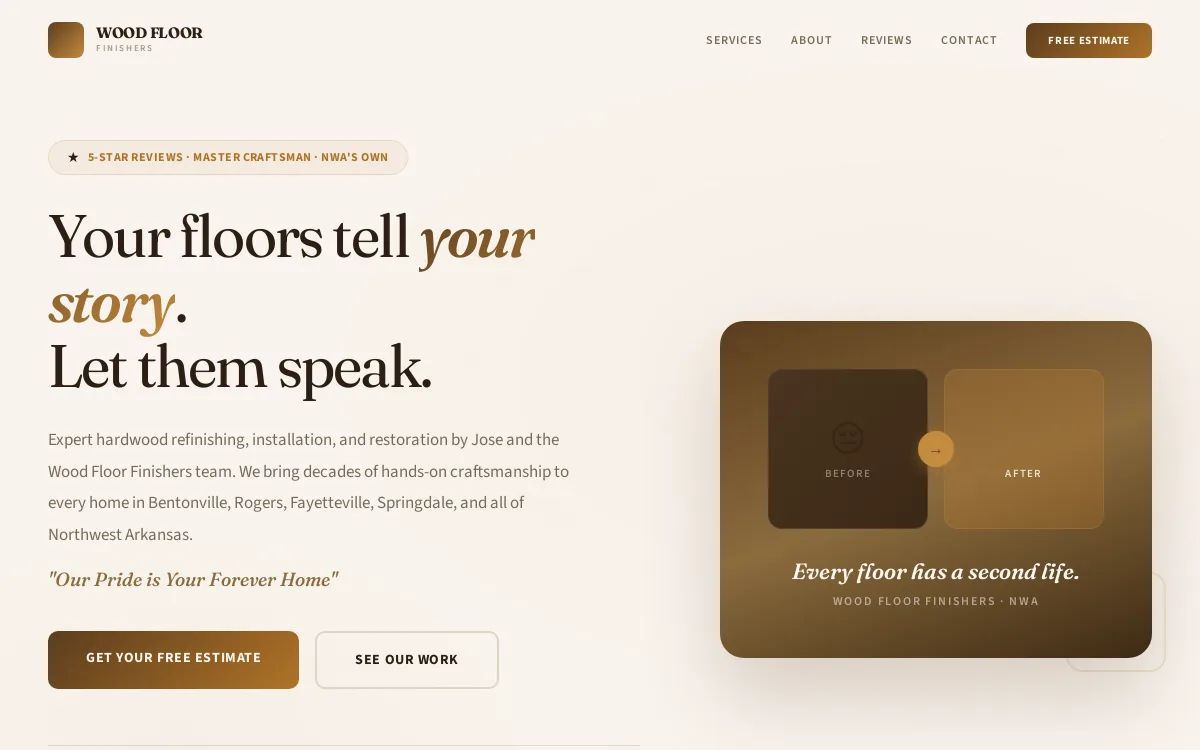
Authority sites for hardwood flooring specialists with image-sitemap optimization for visual search.
2 live builds in this vertical.
Paying-client case studies
Demo builds

Need a site like these?
Tell us what you're building. We'll match the right pattern.
Start a project →What this vertical needs to rank
Hardwood flooring is bought on proof of craftsmanship, not on copy. The people searching are homeowners and builders who already know they want wood floors and are deciding between installation, refinishing, sand-and-refinish, dustless systems, or a new species and finish. Their queries are specific and high-intent: hardwood floor refinishing near me, cost to refinish hardwood floors per square foot, red oak vs white oak, water-based vs oil-based polyurethane, engineered vs solid hardwood, and how long does refinishing take. A site that answers those plainly, with real before-and-after photography attached to each service, is what wins both the map pack and the AI Overview that increasingly sits above it.
This is a visual trade, which is why image handling is a ranking factor here, not a nicety. Google reads finished-floor and in-progress photos through filenames, descriptive alt text, EXIF and structured data, and an image sitemap, then surfaces them in Google Images and Lens. Most flooring sites bury their best work in a slow lightbox gallery with IMG_4821.jpg filenames and no captions, so the exact thing that should sell the job is invisible to search. Pairing every gallery shot with species, finish, sheen, and location context turns the portfolio into crawlable, citable content instead of decoration.
Hardwood work is also an in-home, high-trust purchase: the customer is letting a crew sand, dust, and refinish floors they live on for days. The trust signals that move the needle are concrete: licensing and insurance, NWFA affiliation or manufacturer certifications if they genuinely hold them, written warranties on labor and finish, a clear dust-containment process, and recent, location-tagged reviews. The conversion path should never be a bare contact form. Refinishing and installation are estimate-driven, so the page needs a fast quote request with room count and square footage, a photo-upload option for current floor condition, and a visible phone number, because a homeowner with water-damaged boards or a closing date is calling, not waiting.
The reasons flooring sites fail to rank are consistent. They are single-page brochures with no individual service pages for refinishing, installation, repair, or specific species, so they never accumulate topical depth or qualify for service-specific queries. They omit a real service-area structure, so a regional installer competes for one town instead of every community they serve. They carry no schema, leaving Google to guess whether the business is a store, a contractor, or a manufacturer. And they treat seasonality and material questions, the content homeowners actually research before buying, as someone else's job rather than the authority content that earns the click.
- Distinct service pages for installation, sand-and-refinish, dustless refinishing, board repair, and stair work, each targeting how customers phrase the search.
- An optimized portfolio: descriptive filenames, alt text, captions naming species, finish, and sheen, plus an image sitemap so finished-floor photos rank in Images and Lens.
LocalBusinessplusServiceandFAQPageschema with NAP, geo coordinates, service area, and hours, so engines classify the business correctly and pull facts cleanly.- Service-area pages for each community served, so a regional installer ranks beyond a single home town.
- Visible trust signals: license and insurance, written labor and finish warranties, dust-containment process, certifications held, and recent reviews.
- An estimate-first conversion path with square footage and room inputs, photo upload for floor condition, and a click-to-call number.
Related playbooks: our local SEO framework for service-area structure and map-pack visibility, image SEO and visual search optimization for getting finished-floor photography to rank in Images and Lens, structured data for the LocalBusiness, Service, and FAQ markup engines need, and trust signal engineering for the licensing, warranty, and review proof an in-home trade lives on.
Frequently asked questions
Why isn't my flooring website showing up in the Google map pack?
The map pack is driven by a complete, consistent Google Business Profile and a website whose name, address, and phone number match it exactly, reinforced with LocalBusiness schema and geo coordinates. If your site has no individual service-area pages and no structured data, Google has little to anchor your relevance to a specific town. Adding a page per community you serve, keeping NAP identical everywhere it appears, and steadily collecting location-tagged reviews are what move a flooring business into the three-pack for refinishing and installation searches.
Do photos of my finished floors actually help me rank?
Yes, when they are built to be read by search engines. Google ranks images through filename, descriptive alt text, surrounding caption text, file size and load speed, and an image sitemap, then surfaces them in Google Images, Lens, and AI results. A gallery of IMG_4821.jpg files in a slow lightbox is effectively invisible. Rename each photo to describe the work, write alt text naming the species, finish, and sheen, caption it with the location, and submit an image sitemap. For a visual trade, that turns your best proof of craftsmanship into a discovery channel.
Should I have separate pages for installation and refinishing?
Almost always. Installation and refinishing are different searches, different buyers, and different price structures, and one combined page can't rank well for both. Separate pages for installation, sand-and-refinish, dustless refinishing, board repair, and stair work let each one target how customers actually phrase the query, carry its own photos and FAQ, and build topical depth. That depth is also what AI answer engines quote when someone asks about refinishing cost or timeline, so the structure pays off in both classic search and AI Overviews.
What makes hardwood flooring customers trust a website enough to call?
Refinishing means a crew sanding and finishing floors inside an occupied home for several days, so the trust bar is high. Customers look for proof you are licensed and insured, written warranties on labor and finish, a clear explanation of your dust-containment process, real before-and-after work in their area, and recent reviews. Stating any genuine certifications you hold and showing a concrete process helps too. Surfacing those signals on the page, rather than hiding them, is consistently what turns a flooring site visitor into a quote request.