
Vertical
Federal & Veteran-Owned
Federal contracting sites with SAM.gov/SDVOSB/Section 508 awareness, CAGE/UEI/NAICS schema, and procurement-ready credibility.
2 live builds in this vertical.
Paying-client case studies
Demo builds
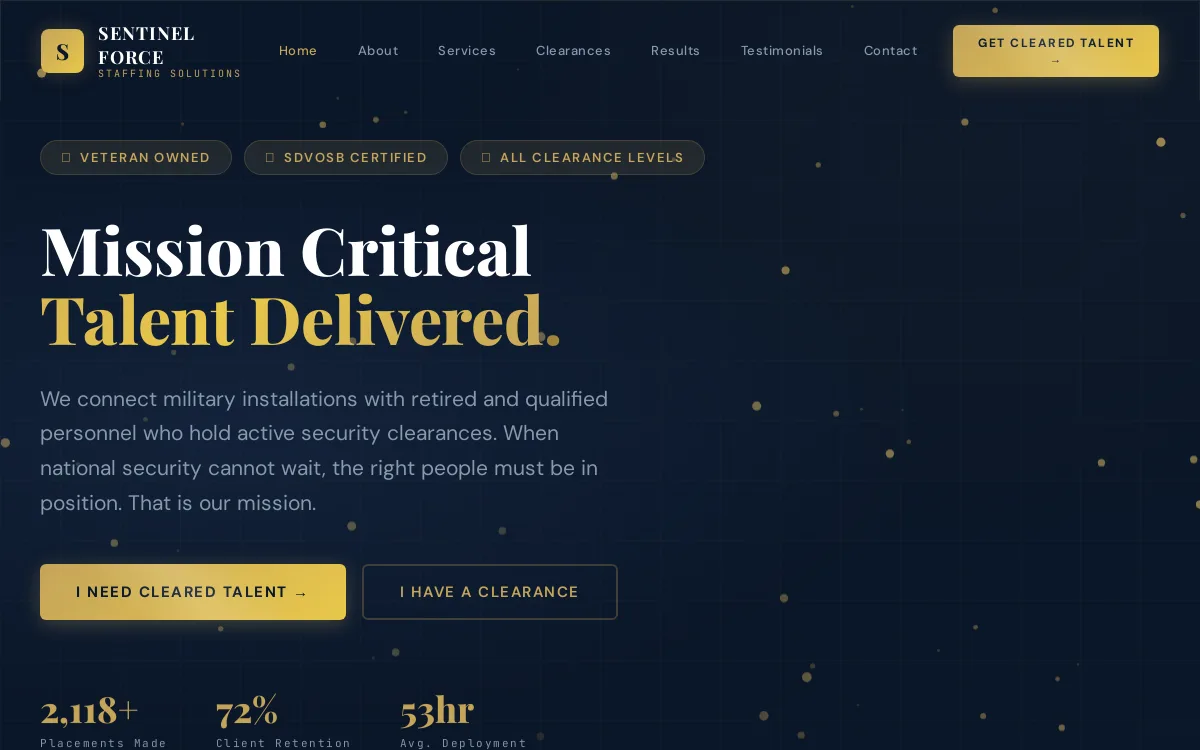
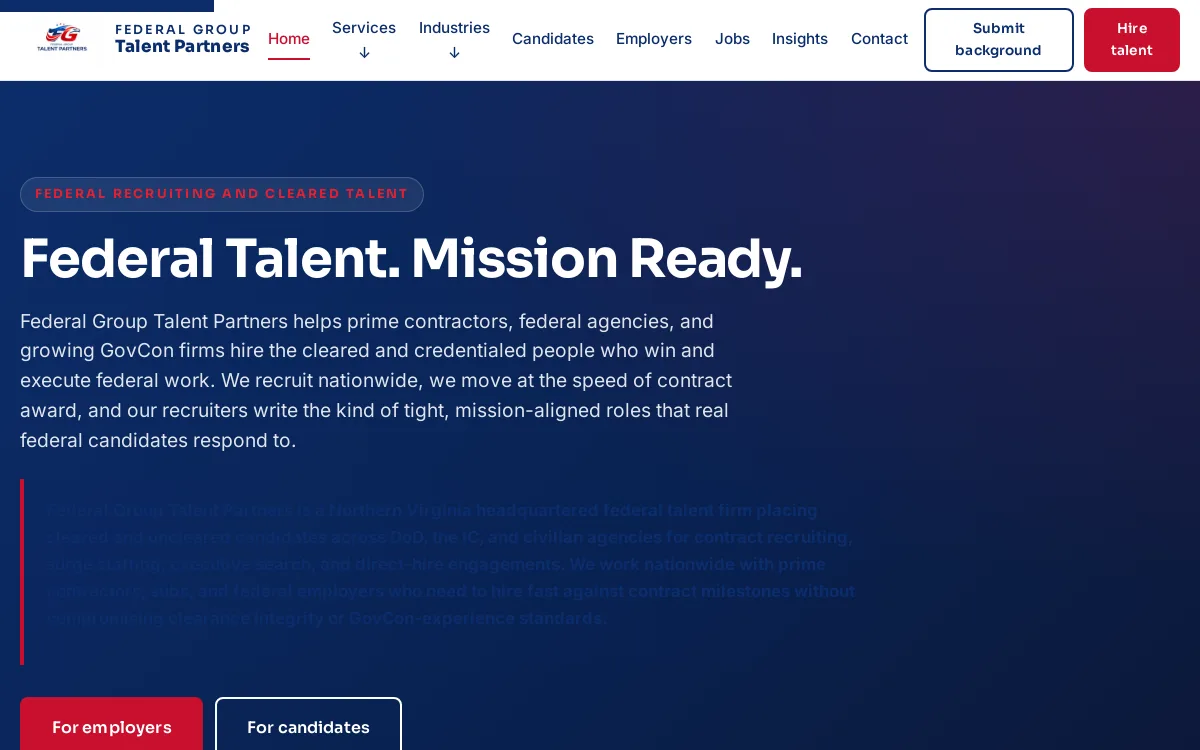
Need a site like these?
Tell us what you're building. We'll match the right pattern.
Start a project →What this vertical needs to rank
Federal and veteran-owned businesses sell to two very different audiences at once, and a site has to serve both. Contracting officers and prime-contractor small-business liaisons arrive already knowing the acronyms; they want to confirm in seconds that you are registered, that your set-aside status is current, and that your NAICS codes match the solicitation in front of them. Commercial and grant-funded buyers arrive cold and need plain-language proof that you can deliver. The pages that win put the capability statement, socioeconomic certifications (SDVOSB, VOSB, 8(a), HUBZone, WOSB as applicable), and core competencies above the fold, then back them with crawlable text rather than a downloadable PDF that search engines and AI assistants cannot read.
The search intent here is unusually specific, which is good news for ranking if the site is structured for it. Real queries look like “SDVOSB [service] [NAICS code],” “veteran-owned [trade] near [base or installation],” “[capability] GSA schedule holder,” and “small business subcontractor for [agency program].” A single homepage cannot answer all of those. The businesses that get found break their core competencies into individual service pages, each naming the work the way a solicitation names it, each carrying the relevant past-performance context, and each linking back to a clean, text-based capability statement page. That is also exactly the structure AI answer engines need to quote you accurately when a contracting officer asks Claude or ChatGPT to shortlist small businesses for a requirement.
Trust is the whole game in this vertical, and it is verifiable trust, not testimonials. The signals that move a contracting officer are your UEI (the SAM.gov identifier that replaced DUNS), CAGE code, registration status, and accurate NAICS and PSC alignment. These belong in the visible content and mirrored into Organization and ProfessionalService structured data so the machine layer can confirm them. Section 508 accessibility is not a nice-to-have in this space; the Rehabilitation Act and WCAG conformance are baked into federal procurement, and a site that fails basic accessibility undercuts the exact credibility you are trying to project. The conversion path is rarely an e-commerce checkout. It is a short, low-friction route to a capability statement download, a contact who can field a sources-sought or RFI response, and clear teaming language for primes looking for a subcontractor.
Most federal and veteran-owned sites fail to rank for predictable reasons. The capability statement lives only in a PDF, so none of its keyword-rich content is indexable. Certifications are claimed in an image or a badge with no text equivalent, so neither Google nor an AI model can read or attribute them. Everything is crammed onto one homepage with no service-level pages to match individual NAICS codes or solicitations. And accessibility is treated as cosmetic, which both hurts the technical foundation and signals the wrong thing to the buyer. Fixing these is mostly structural: get the facts into crawlable HTML, mark them up correctly, and give each capability its own indexable home.
- A text-based capability statement page (UEI, CAGE, NAICS, PSC, core competencies, point of contact) that search engines and AI assistants can actually read, not a PDF-only download.
- Organization and ProfessionalService schema carrying registration identifiers, areaServed, and serviceType so the entity facts are machine-verifiable.
- Individual service pages named the way solicitations name the work, each mapped to the relevant NAICS code and past-performance context.
- Section 508 / WCAG conformance treated as a procurement requirement, not styling: real alt text, keyboard navigation, color contrast, and semantic structure.
- Visible, attributable certification statements (SDVOSB, VOSB, 8(a), HUBZone where applicable) with text equivalents, not badge images alone.
- A clear teaming and subcontracting path for primes, plus a contact route built to handle sources-sought and RFI responses quickly.
Related playbooks: our trust signals framework covers how to make registration identifiers and certifications verifiable rather than decorative, the accessibility framework maps WCAG and Section 508 conformance to the federal requirements that actually get checked, the E-E-A-T framework shows how to demonstrate genuine capability and past performance, the schema framework details the Organization and ProfessionalService markup that carries UEI, CAGE, and NAICS into the machine layer, and the local SEO framework helps target work near specific installations and set-aside regions.
Frequently asked questions
Should my capability statement be a PDF or a web page?
Both, but the canonical version needs to be a real web page. Search engines and AI answer engines extract far less from a PDF than from indexable HTML, and a capability statement is dense with exactly the terms you want to rank for: core competencies, NAICS and PSC codes, differentiators, and your UEI and CAGE code. Keep the PDF as a downloadable leave-behind for contracting officers, but publish the same content as a text-based page so it can be crawled, cited, and matched to solicitations.
How do I show my SDVOSB or set-aside status so it actually helps?
State it in plain, indexable text, not just a badge image. Name the specific certification (SDVOSB, VOSB, 8(a), HUBZone, WOSB) where it applies, and mirror your registration identifiers into Organization or ProfessionalService structured data so the facts are machine-verifiable. An image badge with no text equivalent is invisible to Google and to AI assistants, which is the opposite of what you want when a buyer or a model is checking whether you qualify for a set-aside.
Why does Section 508 accessibility matter for my federal-facing site?
Accessibility under the Rehabilitation Act and WCAG conformance is woven into federal procurement expectations, so a site that fails basic accessibility undercuts the credibility you are trying to project to a contracting officer. It also overlaps almost entirely with technical SEO best practice: semantic HTML, real alt text, keyboard navigation, and adequate color contrast help both assistive technology and search crawlers. Treating it as a procurement requirement rather than styling improves your ranking foundation at the same time.
My homepage covers everything. Why aren’t we ranking for our services?
Federal buyers search at the level of a specific capability and NAICS code, and a single homepage cannot be the most relevant result for every one of them. Break your core competencies into individual service pages, name the work the way a solicitation names it, and map each page to the relevant NAICS or PSC code with its own supporting context. That gives Google and AI answer engines a precise page to surface for each requirement instead of forcing one general page to compete for many different searches.