
Vertical
Cleaning Services
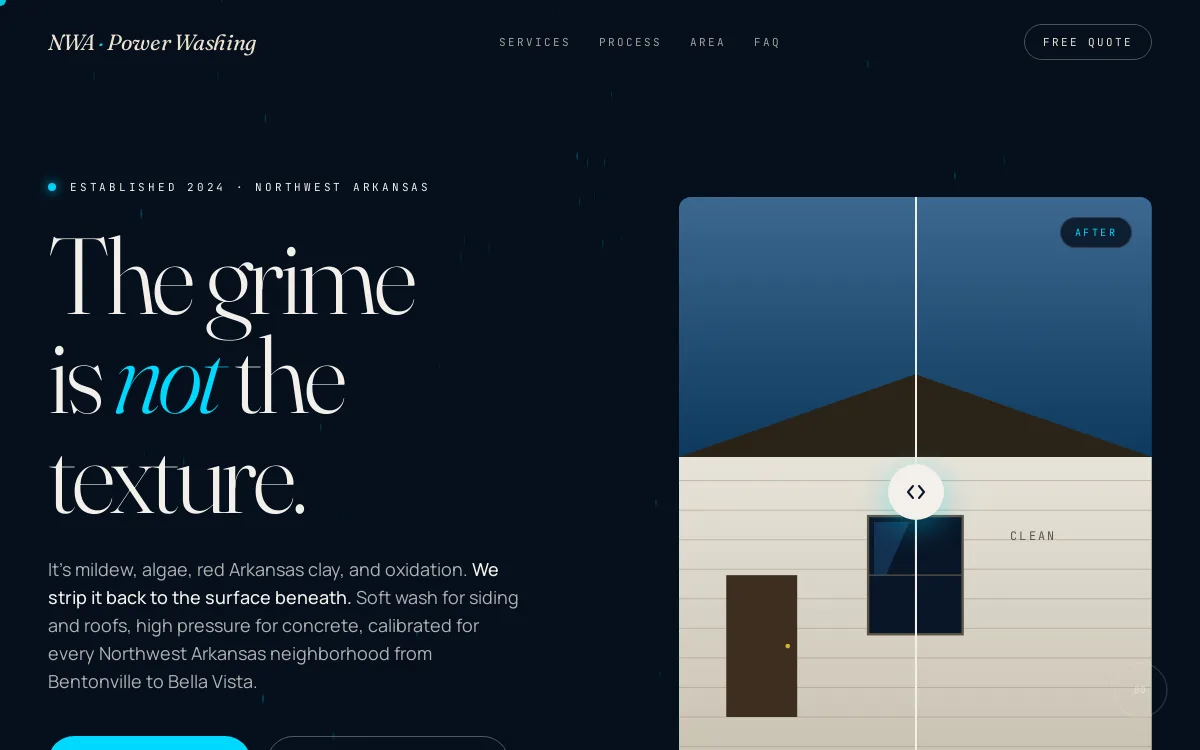
Booking-first cleaning service sites with city-page architecture for multi-city service areas.
8 live builds in this vertical.
Paying-client case studies
Demo builds


Need a site like these?
Tell us what you're building. We'll match the right pattern.
Start a project →What this vertical needs to rank
Cleaning is a trust-and-proximity purchase. People searching "house cleaning near me," "move out cleaning [city]," "recurring maid service," or "commercial janitorial quote" are letting a stranger into their home or business, so they decide on a narrow set of signals: are you insured and bonded, do you actually serve their zip code, what does a recurring visit cost versus a one-time deep clean, and can they book without a phone call. A cleaning website that does not answer those four questions above the fold loses the lead to whoever does. The job of the site is to convert a high-intent local searcher in one session and to feed clean, quotable facts to Google's local pack and to AI answer engines.
Service-type segmentation is the single biggest ranking lever in this vertical, and it is where most cleaning sites fail. Residential recurring, one-time deep clean, move-in/move-out, post-construction, Airbnb turnover, and commercial/janitorial are different buyers with different price expectations and different search terms, but most sites collapse them into one vague "Our Services" page. Each of those deserves its own crawlable page with its own scope-of-work, what is and is not included, and pricing structure, because that is how the page earns long-tail impressions and gives an AI engine something specific to cite. The second failure mode is geography: a cleaner working ten towns needs a real page per service area with locally true content, not a hidden block of city names stuffed into the footer, which Google now treats as doorway spam rather than coverage.
The schema that fits is LocalBusiness or its CleaningService subtype as the anchor entity, individual Service entities for each cleaning type with an Offer describing the pricing model (per visit, per square foot, per room), FAQPage for the objection-handling questions buyers actually type, and Review/AggregateRating only when it reflects genuine collected reviews. Geo coordinates and a defined areaServed tie the entity to the map. The trust signals that matter here are concrete and verifiable: liability insurance and bonding, background-checked staff, supply and product details (pet-safe, eco, fragrance-free), a clear satisfaction or re-clean guarantee, and real reviews with the reviewer's city attached. These belong in visible page copy and in markup, never invented.
The conversion path should be short and bookable: a homepage that names the service area and the cleaning types, a fast instant-quote or booking form that captures square footage and frequency, and a transparent explanation of how pricing works even when a final number requires a walkthrough. Sites in this vertical most often stall in "Discovered – currently not indexed" because the service and city pages are near-duplicate templates with only the town name swapped, the copy is thin, images are heavy and uncompressed, and the booking form is the only unique element on an otherwise boilerplate page. Differentiated, locally true content per service and per area is what moves these pages from discovered to indexed to ranked.
Related playbooks: our local SEO framework for multi-location service-area businesses covers the city-page architecture and Google Business Profile work this vertical lives on, trust-signal engineering details how to surface insurance, bonding, and guarantee proof that converts cautious homeowners, our structured-data playbook maps the LocalBusiness, Service, Offer, and FAQ types to each page, internal-linking strategy shows how to pass equity from city pages into the service pages that actually carry buying intent, and form and quote-flow optimization tightens the booking path so high-intent visitors finish the request.
Frequently asked questions
Why isn't my cleaning website showing up for the towns I serve?
Usually because the service area lives in a footer list of town names rather than on real, individually written pages, which Google reads as a doorway pattern instead of genuine coverage. To rank for each town you need a dedicated page with locally true content — the neighborhoods or zip codes you actually cover, drive-time notes, jobs typical to that area — plus a Google Business Profile with an accurate service-area definition, consistent name, address, and phone across listings, and internal links from those city pages into your service pages. Thin or duplicated city pages with only the town name swapped are the most common reason these stall in "Discovered – currently not indexed."
Should I publish my prices, and will that hurt my rankings or my leads?
Transparency helps both. Buyers comparing cleaners reward sites that explain the pricing model — per visit, per square foot, per room, or recurring versus one-time — even when a firm number needs a walkthrough, and being concrete reduces tire-kicker calls. You do not have to post a single fixed rate; you do need to explain how cost is determined and what changes it (square footage, frequency, deep clean versus maintenance). That clarity is also exactly the kind of specific, quotable fact that Google's AI Overviews and assistants like ChatGPT or Perplexity pull when someone asks what cleaning costs in your area.
How do I get cited by ChatGPT, Gemini, and AI Overviews for cleaning searches?
AI engines quote pages that state facts plainly and back them with structured data. Give each cleaning type its own page with a clear scope of work and what is included, answer the real objection questions (bonded and insured, pet-safe products, re-clean guarantee, how to book) in plain language, and mark up the page with LocalBusiness or CleaningService, Service, Offer, and FAQPage schema. Keep your name, address, and service area consistent everywhere. Engines reward unambiguous, verifiable content over marketing language, so a page that says exactly what a deep clean includes and what it costs to estimate will get cited before a vaguer competitor.
What trust signals actually convert homeowners for a cleaning service?
Because customers are handing over keys, the signals that move them are concrete and verifiable: liability insurance and bonding stated on the page, background-checked or vetted staff, the products you use (eco, pet-safe, fragrance-free), a satisfaction or re-clean guarantee, and real reviews with the reviewer's city shown. Put these in visible copy near your booking form, not buried, and mirror the genuine ones in Review and AggregateRating schema. Never fabricate reviews, certifications, or guarantees — invented trust claims are both a ranking risk under spam and trust policies and a real liability for a service entering people's homes.